Building Confidence with GoGuardian and Broadband: A Teacher’s Journey Toward Meaningful Technology Integration

Starting the Journey
When I first stepped into a classroom equipped with GoGuardian, I wasn’t sure what to expect. Technology can be exciting, but for many teachers, it can also be intimidating. At Midland ISD, I often saw teachers shy away from digital tools because they worried about losing control of their classrooms or watching a lesson collapse when the Wi-Fi dropped. I’ll admit, I was one of them. It’s hard to give your best lesson when you’re silently praying the internet will hold steady. When I transitioned to Hillcrest School, I found myself in an environment that valued innovation along with a growth mindset. That move was a turning point for me. Hillcrest pushed me to think differently not just about what tools we used, but how we could make teachers feel confident enough to take risks. I realized that for technology to thrive in classrooms, teachers needed two things, the right management tools and reliable infrastructure. That’s when GoGuardian and a schoolwide investment in broadband became the foundation for meaningful change. This article tells the story of how pairing a digital classroom management tool with dependable infrastructure changed the culture at my school. It’s about more than Wi-Fi and software, it’s about creating conditions where teachers feel empowered, students feel supported, and technology becomes a reliable partner in learning rather than a constant stressor. More importantly, it’s a story of how leadership and mindset shape technology adoption in ways that affect every classroom experience. But creating those conditions required us to confront real challenges, unreliable broadband, teacher anxiety, and a lack of training. Turning those barriers into breakthroughs became the key to transforming how technology was used at Hillcrest.
From Barriers to Breakthroughs
It’s important to note that broadband reliability is not just a matter of convenience. In underfunded schools or rural districts, the absence of stable internet widens inequities, leaving some students without the same opportunities for blended learning or digital collaboration. At Hillcrest, our investment in stronger broadband leveled the playing field for students from different backgrounds, ensuring that access to learning wasn’t determined by a student’s zip code or their family’s resources.
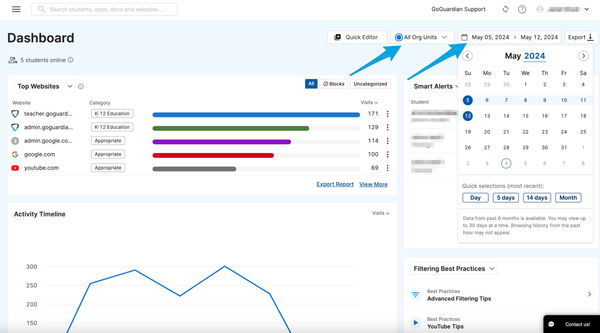
GoGuardian gave us the power to see what students were doing in real time, redirect when necessary, and refocus attention where it belonged, and for me it was the first time I felt like technology was on my side instead of something I had to fight against. That sense of control eased a lot of anxiety for teachers, but we quickly realized GoGuardian couldn’t do everything on its own. Without dependable broadband, lessons froze, connections dropped, and teachers were hesitant to rely on technology. Once our school invested in upgraded bandwidth, the difference was immediate, teachers began experimenting with blended learning, encouraging collaboration, and engaging students in digital projects without the constant fear of failure. My vision has always been shaped by a growth mindset and servant leadership; I don’t want to simply tell teachers what to do, I want to create an environment where they feel supported enough to try new things without worrying about failing.
Drawing on Roger Schank’s (1995) emphasis on diagnosis and modeling, I started by diagnosing the real reasons teachers were hesitant, which came down to unreliable Wi-Fi and a lack of training, and then I modeled how GoGuardian could be paired with stronger broadband to create a safe space for experimentation. The result was that teachers benefitted in three clear ways: less anxiety, more reliable access, and a stronger culture of experimentation. Over time, I have learned that successful integration has less to do with the tools themselves and far more to do with how we support the people using them, and at Hillcrest I’ve watched colleagues who once swore they’d never touch digital tools now leading lessons with confidence because they know they’re not being set up to fail.
Practical Applications and Teacher Experiences
GoGuardian gave our teachers a sense of control we hadn’t experienced before, helping us redirect students and keep them focused, rather than feeling like technology only created distractions. For me, it was the first time I felt like technology was on my side instead of something I had to fight against. Still, we quickly realized GoGuardian couldn’t do everything on its own; without reliable Wi-Fi, even the best software fell short. Investing in stronger broadband gave teachers the confidence that when they pressed “go,” their lessons would run. Guided by a growth mindset and servant leadership, I focused on diagnosing the real barriers, unreliable Wi-Fi and lack of training and then modeled how GoGuardian, paired with stable broadband, could create a safe space for experimentation. The results were clear: reduced anxiety, dependable access, and a culture of innovation. I’ve seen teachers use GoGuardian to check understanding, manage group projects, and even run simulations, and once the broadband improved, those who had once avoided digital tools became leaders in trying new approaches. One colleague’s blended unit rotating between group discussion and online primary-source analysis worked seamlessly, producing deeper engagement and stronger discussions. Personally, I’ve learned integration is less about the tools themselves and more about supporting the people using them, and I’ve seen teachers who once swore off technology now leading lessons with confidence.
Link to My Original Innovation Plan
This journey connects directly to my original innovation plan, which is to implement GoGuardian while strengthening broadband at Hillcrest. It isn’t about adding one more tool, it’s about creating an ecosystem where teachers feel safe to try new strategies and students benefit from engaging, reliable learning experiences. I’ve seen how confidence grows when teachers have both the tools and the infrastructure. As Vorobyov (2024) reminds us, true innovation in schools isn’t about one shiny program, it’s about building sustainable conditions for growth.
Why This Story Matters
This experience also deepened my awareness of equity. While Hillcrest was able to invest in broadband, many schools across the country still struggle with limited infrastructure. The digital divide is not just about devices but about whether every student, regardless of background, can rely on the tools needed to learn. Our story at Hillcrest is one example of what’s possible, but it also highlights why leaders must advocate for equitable access to technology so no student is left behind.
Hillcrest’s journey shows that technology adoption isn’t about one tool or one strategy, it's about creating the conditions for teachers to feel safe experimenting. With GoGuardian and stronger broadband, I’ve rediscovered what it feels like to teach with excitement and confidence, and I’ve watched my colleagues grow braver too. Teachers who once avoided digital tools now lead innovative lessons, not because they suddenly became tech experts, but because they felt safe enough to try. This isn’t just about GoGuardian or faster internet, it’s about leadership, mindset, and building systems that empower teachers and students alike. Schools cannot expect innovation if the foundation isn’t stable. When leaders make intentional investments in both tools and infrastructure, they send a clear message, we believe in you, we want you to take risks, and we’ll give you what you need to succeed. This journey has reinforced why I believe in servant leadership and a growth mindset. True leadership isn’t about mandating technology use, it’s about walking alongside teachers, modeling strategies, and making sure no one feels like they’re taking risks alone. And in the end, that’s the story I want to share, when teachers feel supported, they make technology work for them instead of against them.
References
GoGuardian Help Center. (2024, June 4). Dashboard overview.
GoGuardian. https://support.goguardian.com/s/article/Dashboard-Overview-1629767891993
Kotter, J. (2011). Leading change: Establish a sense of urgency [Video]. YouTube.
https://www.youtube.com/watch?v=2Yfrj2Y9IlI
McMahon, D. (2021, November 22). How this tool ended teachers’ tech fears and addressed
students’ social-emotional needs. EdSurge.
https://www.edsurge.com/news/2021-11-22-how-this-tool-ended-teachers-tech-fears-and- addressed-students-social-emotional-needs
Pew Research Center. (2021). Internet/Broadband fact sheet.
https://www.pewresearch.org/internet/fact-sheet/internet-broadband/
Thibodeaux, T. (2013, April 15). 6 Strategies for Successful Co-teaching. Edutopia.
https://www.edutopia.org/article/effective-co-teaching-strategies/
Schank, R. (1995). Invisible learning: The revolution outside of the classroom. Education
Futures. https://educationfutures.com/post/invisible-learning-the-revolution-outside-of-
the-classroom/
Vorobyov, S. (2024, February 1). Technology-driven education: A new era of learning. Forbes.
https://www.forbes.com/councils/forbestechcouncil/2024/02/01/technology-driven-education- a-new-era-of-learning/